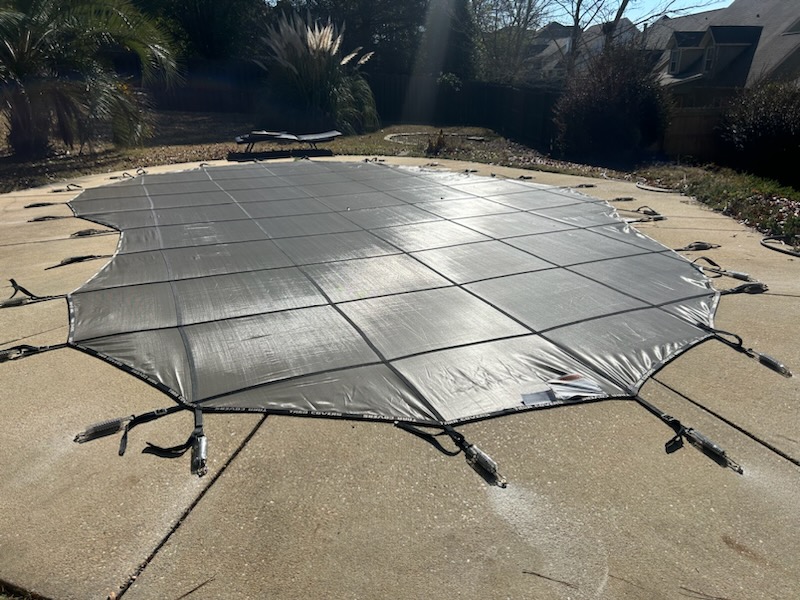
If you’re getting your pool ready for the off-season in Auburn or Opelika, one of the biggest decisions is what goes over the water once it’s closed. Clear H2O installs both mesh and solid safety covers, and “which one should I get?” is one of the most common questions we hear this time of year. The honest answer is that both are good choices — they just trade off in different ways. This guide walks through how each one works, what it means for your pool over an East Alabama winter, and how to decide.
First: What Makes a Cover a “Safety” Cover?
A lot of pools get closed with a basic winter cover — a tarp-style sheet held down around the edges with water bags or blocks. Those covers keep out lightweight debris, but they aren’t built to hold weight. If a child, pet, or wild animal steps onto one, the cover can sag into the water. Rainwater that collects on top can also pull a loose cover down into the pool, dumping leaves and dirty water in with it.
A safety cover works differently. It’s custom-fit to the shape of your pool and stretched tight across the water with straps that attach to anchors set into your deck. Springs on each strap keep the cover taut so it stays in place and flexes slightly under load instead of collapsing. Industry guidance points to the ASTM F1346 standard for safety covers, which covers things like load-bearing performance and how securely the cover attaches — so if you’re comparing covers, it’s worth asking whether the product meets that standard.
Good to know: A safety cover is an added layer of protection, not a replacement for adult supervision, fencing, or gates. Keep the cover properly secured whenever the pool isn’t in use.
Every safety cover we install is custom-fit — rectangular, freeform, and irregularly shaped in-ground pools all included — and securely anchored and strapped down. The real choice is the material: mesh or solid.
Mesh Safety Covers
A mesh cover is made from a tightly woven fabric that keeps leaves, sticks, and other debris out while letting water pass through.
Advantages of Mesh
- Rain drains right through. Water doesn’t pool on top, so there’s no cover pump to run and nothing to keep an eye on after a storm. For a part of Alabama that sees plenty of winter rain, that’s a big plus.
- Lighter weight. Mesh is easier to handle, fold, and store than solid material, which makes taking it off in the spring a simpler job.
- Less to manage over the winter. Because water can’t collect on top, a mesh cover is about as close to “set it and forget it” as pool covers get.
Trade-offs of Mesh
- Sunlight gets through. Some light passes through the weave, which can encourage algae growth during warm stretches of the off-season — something East Alabama sees plenty of between cold snaps.
- Fine particles get through, too. Mesh stops leaves and large debris, but fine dirt, silt, and pollen can wash through with rainwater.
- The water level rises. Since rain drains into the pool, you may need to lower the water level during a wet winter, and it’s more common to need some cleanup at opening time.
Solid Safety Covers
A solid cover is made from a material that blocks water and sunlight. It’s anchored and strapped down the same way a mesh cover is, but it seals the pool off from what’s happening above it.
Advantages of Solid
- Blocks sunlight. With no light reaching the water, algae has a much harder time getting started, which usually means cleaner water when you pull the cover in spring.
- Keeps out fine debris. Dirt, pollen, and rain runoff stay on top of the cover instead of washing into the pool.
- Steadier water. Since rain doesn’t drain into the pool, your water level and chemistry tend to stay more stable through the winter.
Trade-offs of Solid
- Water collects on top. Rain has nowhere to go, so a solid cover generally needs a cover pump (or a design with a drain panel) to keep standing water from building up. That’s a bit of ongoing attention during rainy months.
- Heavier. Solid material weighs more, so the cover is more work to take off, clean, and store.
- Spring removal takes more care. Any water and debris sitting on top need to be pumped and cleared off before the cover comes off, so they don’t end up in the pool.
Mesh vs. Solid at a Glance
- Rainwater: Mesh drains through; solid needs a cover pump or drain panel.
- Sunlight & algae: Mesh lets some light through; solid blocks it.
- Fine debris & pollen: Mesh lets fine particles wash through; solid keeps them out.
- Weight & handling: Mesh is lighter and easier to store; solid is heavier.
- Winter upkeep: Mesh is lower-maintenance; solid needs water removed from the top.
- Spring opening: Mesh may need more water cleanup; solid usually means cleaner water but more care removing the cover.
Which Is Better for Auburn & Opelika Pools?
There isn’t one right answer for every backyard, but a few local factors usually tip the decision:
- How much rain you’re willing to manage. Our winters are mild compared to the North, but they’re wet. If you don’t want to think about pumping water off a cover after storms, mesh is the easier option.
- How many trees are around your pool. Fall leaf drop is heavy in a lot of Lee County neighborhoods. Both covers keep leaves out of the water; a solid cover also keeps out the fine material and tannins that wash off wet leaves, while mesh lets that drain through.
- How clean you want the water at opening. If a cleaner spring opening is your top priority and you don’t mind running a cover pump, solid has the edge.
- Who will be taking the cover on and off. If you’ll be handling the cover yourself each season, the lighter weight of mesh is worth considering.
- How long the pool will be closed. The longer and warmer the off-season stretch, the more sunlight blocking matters for keeping algae in check.
If you can’t decide, that’s exactly the conversation we have with customers every fall. Call us at (334) 821-7809 or stop by the store at 520 Opelika Road and we’ll help you weigh the trade-offs for your specific pool.
Getting the Most Out of Your Safety Cover
Whichever material you choose, a few habits help the cover protect your pool and last longer:
- Close the pool properly first. A cover keeps debris out, but it doesn’t balance or winterize your water. Pairing installation with a full pool closing & winterization means the pool is treated and protected at the same time.
- Keep it taut. Check that every strap is hooked to its anchor and the springs are holding tension, especially after storms or high winds.
- Clear heavy debris. A leaf blower or soft broom keeps leaves from piling up on the cover. On a solid cover, keep standing water pumped off.
- Inspect it each season. Look for worn straps, rusted springs, loose anchors, and thin spots or tears in the material before it goes back on.
- Clean and dry it before storage. Hose the cover off, let it dry completely, and store it somewhere rodents can’t get to it. When the cover comes off, the deck anchors can be screwed down flush so they’re out of the way for the swim season.
Safety Cover FAQs
Is a mesh or solid safety cover better?
Neither is better in every case. Mesh covers let rainwater drain through, are lighter, and need less attention over the winter, but they let some sunlight and fine debris into the pool. Solid covers block sunlight and fine debris for cleaner water at opening, but they need a cover pump or drain panel to remove standing water and are heavier to handle.
Do I need a cover pump with a safety cover?
With a mesh cover, generally no — rainwater drains through the material. With a solid cover, water collects on top, so you’ll typically need a cover pump or a cover with a drain panel to keep standing water from building up.
What’s the difference between a safety cover and a winter cover?
A basic winter cover is a tarp-style cover held in place with water bags or blocks. It keeps out light debris but isn’t designed to hold weight. A safety cover is custom-fit to your pool and anchored to the deck with straps and springs, so it stays taut and adds a layer of protection over the water.
Can a safety cover fit a freeform or irregularly shaped pool?
Yes. Clear H2O installs custom-fit safety covers on rectangular, freeform, and irregularly shaped in-ground pools, securely anchored and strapped around the perimeter.
Can I get a safety cover installed when my pool is closed?
Yes. Many Auburn and Opelika customers have their safety cover installed at the same time as their pool closing, so the pool is protected the moment it’s shut down. A safety cover can also be installed on its own, any time of year.
Related Services
- Safety Covers — custom-fit mesh and solid cover installation
- Pool Closing & Winterization — protect your pool over the off-season
- Pool Opening — get your pool swim-ready in spring
- Gallery — photos of safety covers we’ve installed
Ready to Cover Your Pool for the Season?
Clear H2O has been serving Auburn & Opelika pool owners since 2004. Call us for a safety cover quote, or ask about pairing installation with your pool closing.